Your capsule expands without adding outfits because most new pieces can only survive in one or two dress codes. When the fabric’s weave, density, and fiber texture signal casual, it cannot credibly pair with anchors built for business casual or smart casual, so your combination math stays flat. Color matching does not override that physical ceiling.
There is a tradeoff you feel in-hand: softer hand-feel often means lower cross-context function. A slub linen feels wonderful for weekends but leaves a business-casual bridge empty, forcing the next purchase. Fiber disclosure is mandated by federal rules, letting you decode construction before trying on. Once you read that dress-code ceiling in 30 seconds, the loop that turns a closet full of almosts into endless buying becomes obvious.
The Growth Loop You Can’t See on the Hanger
A wardrobe bottleneck is not a missing color or a missing silhouette. It is a garment that only works in one specific pairing. When that piece arrives, it feels like progress because your closet count goes up by one. Functionally, it isolates. It cannot meet your business-casual Monday, your smart-casual dinner, and your low-key weekend without looking forced in two of those three.
Because it cannot connect, it cannot multiply. A true capsule anchor works by bridging. If you own a navy crepe trouser that reads business-casual through casual, any new top that also credibly covers that same span will pair with it three ways. A top that only lives in casual covers one. The result: you bought volume, but your usable outfit combinations stayed flat.
What follows is the substitution cycle that quietly inflates capsules. The isolated top sits unworn for work, so you buy a work-appropriate blouse to compensate. That blouse’s open-weave linen fails at smart-casual events, so you add another layer. Each purchase patches the dress-code gap left by the previous fabric, rather than closing it — low-quality or misjudged fabrics limit options even when pieces look great individually, which is exactly why that weight guide matters more than a color story.
Diagram showing how single-context fabrics increase closet volume without increasing usable outfit combinations.
What Fabric Actually Controls: The Three Variables That Set Your Dress Code Ceiling
Fabric is not a vibe. It is a structure that signals formality at a distance and behaves under body heat. Three variables interact to set that ceiling long before styling enters.
1. Density, proxied as GSM. Grams per square meter tells you how much yarn is packed into a square meter. That packing dictates whether the material collapses or holds. Low GSM around 120–160 — typical for tee jerseys and voile — drapes softly and follows contours, which reads casual. Mid-weight 170–240 holds enough body for polos, uniforms, and casual shirting. Heavy 250–350, used for hoodies, ponte, and outer layers, holds shape and a pressed edge. That edge retention is why a weight guide and drape description matter: low GSM follows the body and moves, high GSM maintains form, directly shifting how formal it can read.
2. Construction category. Two fabrics at identical GSM can live two dress-code levels apart because of how their loops or yarns interlace. Ponte Roma is a medium to heavyweight double-knit with two jersey layers interlocked on a double bed, giving it stability and a near-woven surface. That construction is why it is described as ideal for garments that need structure plus stretch. Single jersey, by contrast, is a single layer, breathable and lightweight — perfect for layering but openly casual in its movement. The textile definition is literal: a double jersey is two layers interwoven, smooth on each side, with interlinked loops that balance shrinkage and increase firmness, a detail you can verify in an interlock definition. Plain, twill, and stretch-crepe wovens sit higher because their tight, diagonal or pebbled surfaces mimic suiting.
3. Fiber texture. Bast fibers like linen naturally form slubs and irregularities. That texture scatters light and signals informality, even in a dark neutral. A smooth polyester-viscose blend at the same weight reflects light evenly and reads more formal. This is why retailers’ “dress up or down” claims fail: you cannot dress up an open-weave slub if its surface itself is broadcasting casual.
Interactive diagram showing how density, construction, and fiber texture combine to set how many dress codes a garment can cover.
| Construction Category | Typical GSM & Signal | Dress Codes Credibly Covered | Anchor Role? |
|---|---|---|---|
| Ponte / Double-Knit | 180–300, stable near-woven surface, holds crease | Business Formal → Casual (3–4 codes) | Yes — prime bridge |
| Plain / Twill / Stretch Crepe Woven | 200–260, tight diagonal/pebbled surface | Business Formal → Smart Casual (2–3 codes) | Yes if 3+ |
| Single Jersey | 150–190, breathable, visible drape | Smart Casual, Casual (1–2 codes) | No — casual duplicate |
| Open-Weave Linen / Slub Natural | ~130–180, irregular slub, light scatter | Casual (1 code), sometimes Smart Casual in dark tones | No — isolation risk |
Colour-Matched But Construction-Blocked
Place a cream slub linen blouse next to a cream ponte blouse. Swatched for color, both pass your palette. Held up to light and folded, they diverge by up to three dress codes. The slub’s surface texture broadcasts resort, limiting you to weekend, while the ponte’s interlocked density mimics a woven blazer blouse and survives a client meeting, dinner, and weekend without looking borrowed. That gap is not styling — it is physics. True cross-context function lives in construction, not the product copy that calls everything versatile.
The Three-Context Threshold — When Fabric Qualifies as a Capsule Anchor
The threshold is simple and brutal: if a piece cannot credibly cover at least three of your actual dress-code points, it will not multiply your closet. Three is the mathematical minimum where one new top can meet one multi-code bottom in more than one setting. Below three, you are buying a duplicate for a code you already own.
Map your real week first, not an aspirational one. Most readers run two to three codes: Business Casual (Mon-Wed client-facing), Smart Casual (evening/dinner), Casual (weekend). If your week is only Business Casual + Casual, then the effective threshold is both plus a bridge piece that handles both — still two distinct codes, but the garment must prove it can live in both without styling gymnastics.
Run the audit on five most-worn and five least-worn pieces from your closet. This keeps the test honest: your favorites usually already pass, your least-worn often fail for fabric, not fit. The worksheet below mirrors the federal labeling habit of listing fiber by percentage weight, which you can legally expect on the care label in the US. Use that disclosure to classify construction rather than guessing from hand-feel alone.
Gauge showing whether a fabric’s construction covers enough dress codes to qualify as a capsule anchor.
| Piece | Fiber + Construction | Approx GSM / Fold | Dress Codes Covered | Pass/Fail | Gap? |
|---|---|---|---|---|---|
| Cream ponte blazer | 60% poly / 35% rayon /5% spandex; double-knit | ~300 / holds edge | BF, BC, SC, C | Pass | No |
| Slub linen shirt | 100% linen; open-weave natural | ~170 / springs open | SC, C | Fail | Yes — blouse anchor missing |
| Navy stretch crepe trouser | 65% poly /33% viscose /2% elastane; crepe woven | ~240 / holds 2 sec | BC, SC, C | Pass | No |
| Grey jersey tee | 95% cotton /5% elastane; jersey | ~180 / springs open | C | Fail | No — casual already covered |
How to Evaluate Fabric Versatility Before You Buy (Without a Lab)
You do not need a lab. You need 60 seconds and the label that is already legally required. The FTC rules mandate fiber content, origin, and care, and construction guide resources confirm what that content implies for structure.
Check 1 — Read the label for construction language. Fiber must be listed by percentage weight, sorted highest to lowest. Look for the descriptor word: ponte, double-knit, interlock, twill, crepe, jersey, slub linen, French terry. That word tells you more than the brand’s “tailored” claim. Ponte or interlock = double-bed interlock, stable, anchor-leaning. Twill, gabardine, stretch crepe = woven, anchor-leaning if mid-weight. Single jersey, slub, open-weave, gauze = casual-leaning. If GSM is printed, use it: under ~170 will drape and signal casual, 180–260 is the versatile band for most year-round capsules, 250+ holds structure for blazers and trousers.
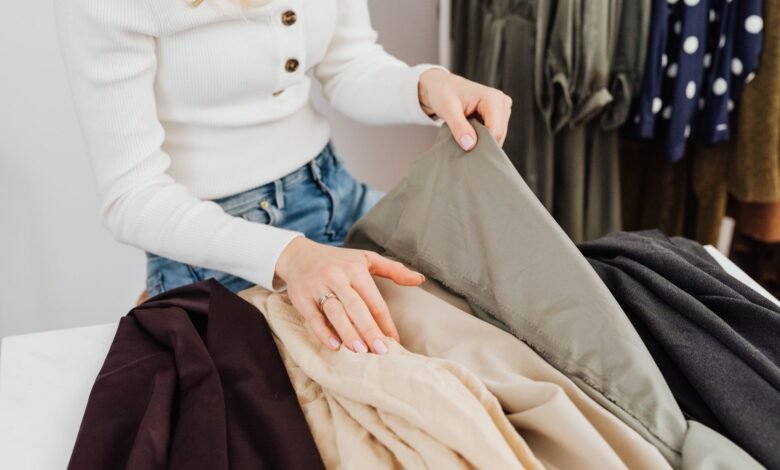
Check 2 — Run the physical fold test. Fold a flat panel against itself and press the crease hard with your thumb for three seconds. Does it hold a sharp edge? That edge retention is a proxy for density and finishing that prevents collapse under body heat and office lighting. If it springs open immediately, it will relax into a casual drape by noon, no matter how it looked on the hanger. Also check opacity drape: let the sleeve fall over your hand. If knuckles disappear behind a stable surface, formality rises; if you see knuckle contour and movement, it leans casual.
Check 3 — Map to three real occasions from the last seven days. Not “could I wear this to a wedding?” but “Could I have worn this to Tuesday’s client review, Thursday’s dinner, and Saturday’s market without a full change?” Name them out loud. If you cannot honestly place it in three, you are about to buy a bottleneck — a single-context piece that duplicates capacity you already own while leaving the bridge role empty. That is the exact mechanism that expands volume without gaining function.
Three-step pre-purchase fabric versatility check to run before any capsule addition.
The Capsule Verdict: Choose Fabric That Multiplies Contexts, Not Closet Volume
Your capsule does not expand because you own too few pieces. It expands because a subset of what you own cannot bridge dress codes due to low-density, open-weave, or slub construction that caps formality. Each such piece solves one occasion while leaving the anchor role vacant, guaranteeing the next purchase.
The fix is structural, not chromatic. Run the four-piece audit tonight: two most-worn, two least-worn. Record fiber, construction word, fold result, and real codes covered. Any fail that also represents a silhouette you lack is a true structural gap — source a ponte, twill, or stretch-crepe equivalent in the 180–300 GSM band next. Any fail that duplicates casual capacity you already have is a candidate to release. Once every piece in your closet passes the three-context test for your actual week, volume stops growing because every new addition finally multiplies.
Frequently Asked Questions
Does the three-dress-code minimum still apply if my life only spans work and weekend?
Adjust the count to your life, not an ideal. If you live only in Business Casual and Casual, a piece must credibly cover both without styling workarounds. The key is multiplication: it must pair with bottoms from both worlds. If it only works for weekends, it is duplicating a capacity you already own and will drive a compensatory work buy.
Can two pieces at the same GSM behave differently across dress codes because of their construction?
Absolutely. A 280 GSM ponte double-knit holds a pressed edge and reads near-woven due to its interlocked two-layer stability, while a 280 GSM single jersey still drapes and signals casual. GSM tells you density; construction tells you surface behavior and formality signal. You need both.
What is the fastest in-store test when GSM isn’t listed?
The fold test. Fold a panel against itself, press hard for three seconds, release. If it holds a sharp crease, density and finishing are likely high enough for Business Casual+. If it springs open and the surface moves, expect a casual ceiling. Pair that with the label’s fiber and construction word.
Should I ever keep a piece that fails the fabric versatility threshold?
Yes, temporarily, if it is the only piece filling a silhouette function and you have no passing equivalent. Keep it while flagged as a structural gap, and make the qualified replacement your next purchase. Do not add other failing pieces around it — that just extends the substitution loop.